Impressions climb while clicks fall: top-of-funnel has moved into AI. There, relevance rules - consistency earns visibility, accuracy drives conversion - and three pillars make a GEO strategy.
For years, the funnel was the foundation of digital marketing strategies. From awareness and consideration to decision, customers moved down it, and every channel had a stage to defend. That funnel is breaking. A single conversation now contains the compressed journey, and the top of the funnel is being handed to large language models (LLMs) before customers ever type your name.
AI is becoming the default interface for search
The line between traditional and artificial intelligence (AI) search is blurring. TechCrunch reported that AI Overviews now appear on 43% of tracked Google searches, citing Similarweb data. In January 2026, Google started allowing users to ask follow-up questions from an AI Overview. Similarly in February 2026, Bing rolled out multi-turn Copilot search. Google announced in May 2026 that AI Mode passed one billion monthly users. In August 2026, Google began testing a homepage that replaces the classic Search button with three AI shortcuts - Create images, Ask about files, and Brainstorm - with AI Mode embedded in the search bar itself. Whether or not that test rolls out globally, the direction is unambiguous - AI is becoming the default interface for search. Traditional ranked results are becoming the evidence layer that feeds it.
The consequence for brands is not that search engine optimisation (SEO) stops working. It is that the goal has changed.
The job now is to be relevant wherever customers ask - search engines, AI assistants, social platforms, forums, review sites - and to appear consistently and accurately across all of them. Relevance is the new currency in AI search.
The clicks stopped coming
The zero-click shift is measurable in organic search data, and it is not subtle. This is SEO having its K-shaped moment - impressions up one arm, clicks down the other. Two of our clients in Australia were asking: why did clicks stop coming? The real question is, where did they go? Here’s what we found.
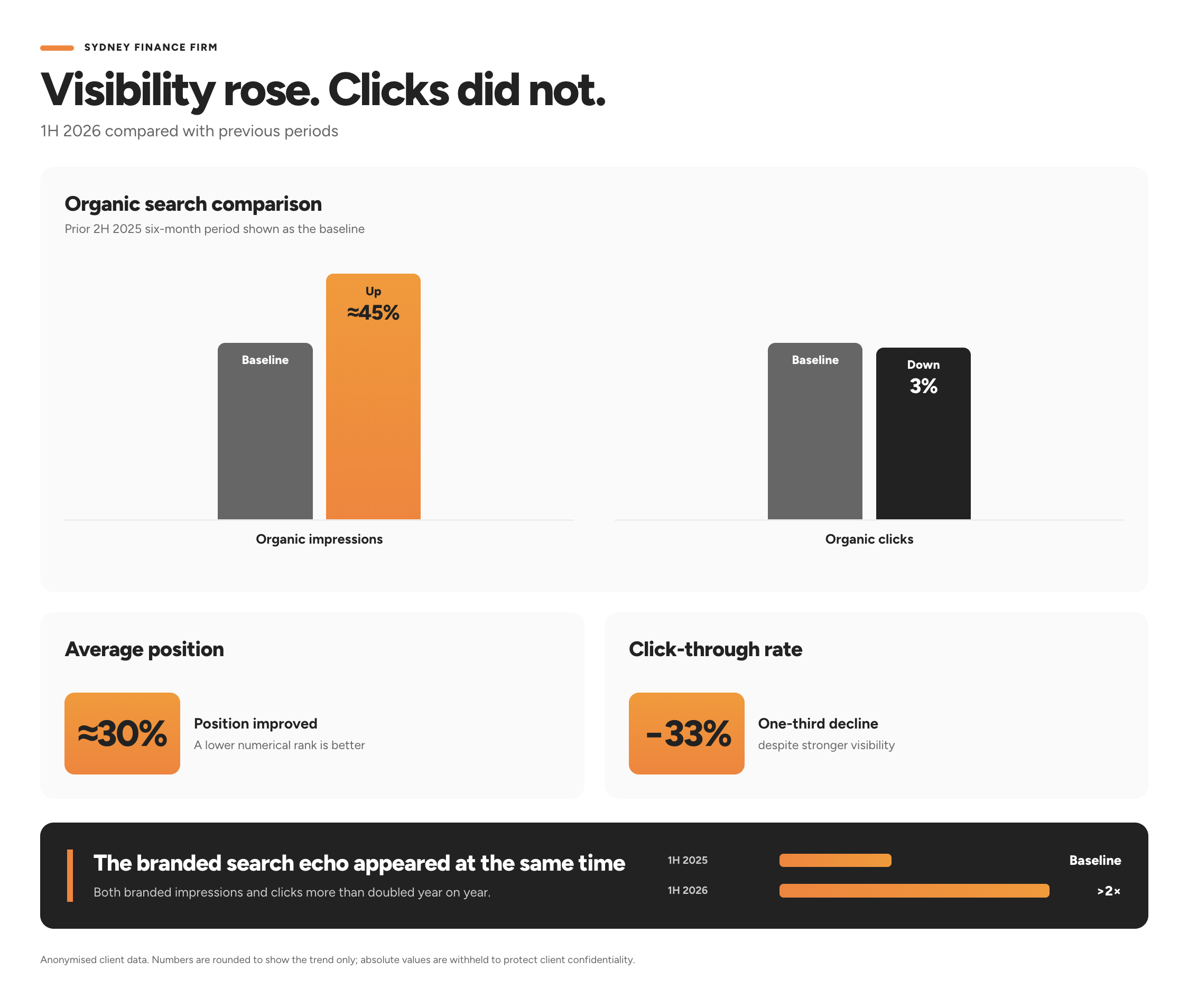
A Sydney-based finance firm saw organic impressions in the first half of 2026 (1H 2026) jump by nearly 45% from the previous 6-month period (2H 2025), but organic clicks have declined, cutting click-through rate (CTR) by a third. This happened despite their average position improving by nearly 30%. Meanwhile, we observed that both branded search impressions and clicks more than doubled year-on-year (YoY).
Similarly, a distribution business in Queensland lost 1/4 of organic sessions and nearly 20% of organic users in 1H 2026 versus the same period a year earlier. Organic’s share of total traffic dropped from more than half of the total to roughly a third - a seventeen-percentage-point collapse. And yet, branded search impressions and clicks both grew more than 50%, and CTR increased nearly 10%. Direct sessions and users also doubled.
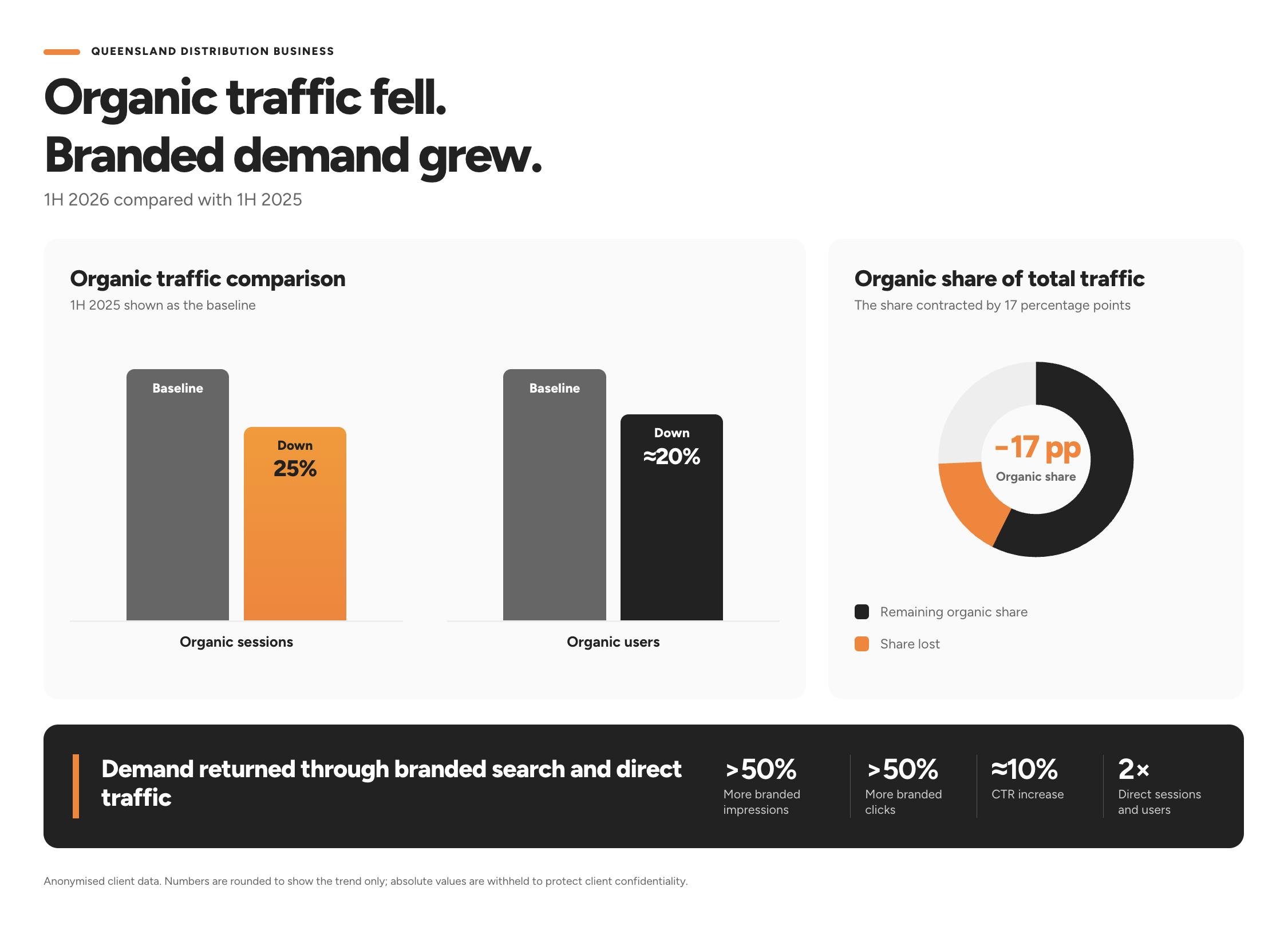
Two clients, two sectors, one pattern: non-branded organic collapsing while branded search and direct traffic expand....
Customers are not searching less. They are either arriving already convinced, or not arriving at all.
The branded search echo
We call the pattern the branded search echo. It refers to what happens when AI systems pre-qualify a purchase decision inside the conversation, then the customer searches your brand name to verify what the AI told them.
By the time that branded search happens, the top-of-funnel work has already occurred somewhere you can’t see. The AI Overview cited a competitor. The ChatGPT answer summarised your product category. Perplexity linked to a review site. The customer took that information, formed a shortlist, and only then reached for a search engine to check the brand names that made the cut.
The branded search echo has two immediate implications for measurement. First, the growing gap between impressions and clicks is not a ranking problem, it is an evidence problem happening upstream. It is visibility without visits. Second, increased branded search and doubled direct traffic are the visible tail of what is partially dark AI-referred traffic. AI systems influence the decision, but most of the time they do not leave a trace in the referrer header. What used to be a measurable click has become a branded search or a direct visit with no attribution.
The top of the funnel moved into the prompt
The average Google query is 3.37 words (HubSpot citing the Growth Memo report). The average ChatGPT prompt is 23 words. That difference is where the top of the funnel went. Users compress research, comparison, and intent into a single, context-rich question, and hand the shortlist-building work to the AI.
Modern search algorithms have moved beyond keyword matching, and large language models have “language” in their name for a reason.
Natural language processing evaluates what the user is looking for by matching problems with solutions. The response depends on entities - who you are, what you offer, where you operate, and what problems you solve. Machines have to be able to read those signals cleanly and pass on the information accurately. Get any of that wrong and you drop out of the answer.
This is why all the fancy new terminology arrived. Generative engine optimisation (GEO), answer engine optimisation (AEO), AI optimisation (AIO) - they all describe optimisation for the AI systems from slightly different angles. The label matters less than the mechanic. Being cited depends on relevance, and relevance is determined by entities and context, not keyword density.
In AI search, you trade relevance for visibility
To make the cut inside an AI answer, relevance is now the currency you spend. AI systems evaluate what you have to offer with what the user has asked, using intent mapping and entity matching to produce a response. Relevance decides whether you are eligible.
AI search is not deterministic, it is probabilistic. LLMs produce answers by probability, and every citation is a weighted decision made from many candidates. Higher relevance raises the probability that your brand appears; consistency raises the probability that it appears again; accuracy raises the probability that the referral converts.
Being cited once is a data point. Being cited reliably is a strategy. Two other properties decide whether you show up and stay there...
- Consistency earns visibility
A relevant answer has to come up consistently for AI systems to recommend you. What your website says has to match what your social channels say, what your reviews say, and what third-party sources say. Each corroboration accumulates evidence; each contradiction adds doubt. - Accuracy drives conversion
Once AI systems send a customer to you, what you claim has to reflect what you deliver. The content that lands them should identify who it is for, what problem it solves, and what your customer can expect. Inaccurate content wins a citation and a visit, but loses the sale.
Relevance, consistency, and accuracy are outputs. What produces them sits underneath.
SEO is not dead, it teamed up with GEO
GEO, AEO, and AIO are not new species - they're SEO under new pressure. Most SEO practices that worked before still work now and three of them matter more than ever:
- SEO demands technical hygiene, and GEO is even more unforgiving
Page load speed, robots.txt configuration, rendering behaviour, and structured data all decide whether AI systems can retrieve your content. Google and Bing have spent two decades building indexing infrastructure that forgives technical weakness. AI platforms have not. The economics of inference make LLMs unforgiving, allocating compute to the most retrievable content. The winner is usually whoever is most efficient at serving it. - SEO matched keywords, GEO extends to intent & context
Long-tail keywords and AI prompts require natural language processing on the way in, and context-aware answers on the way out. Meta titles, meta descriptions, headlines, and content structure all still matter - they matter more now, because a machine relies on clarity to tell which intent your page satisfies. Lack of clarity results in intent mismatch, and mismatched intent converts poorly. - GEO takes SEO into search-everywhere optimisation
AI search behaves like a real customer. A customer doesn’t see you on a search engine once and place the order. They watch a YouTube ad, read a social post, ask ChatGPT, check reviews on Google, and then visit your website. AI systems evaluate the same trail. Each touchpoint needs nurturing, and they need to work as one system.
Three pillars behind every GEO strategy
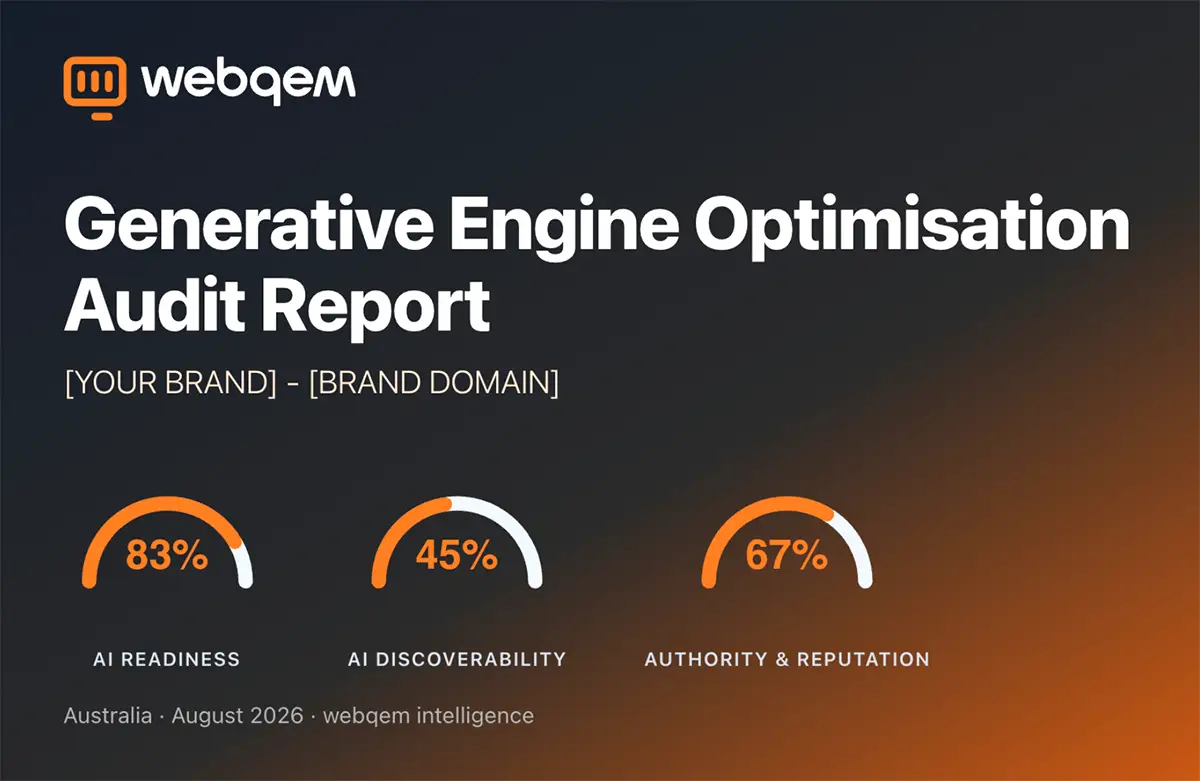
When brands measure AI visibility, personas and test prompts often get most attention. Share of voice and sentiment scores dominate the reports. Both are outputs but neither is a lever.
The levers are three pillars we assess in every GEO audit, and they map directly onto what our client data shows:
- AI readiness refers to whether machines can access and process your site. A huge influencer is page speed. It also covers hosting, rendering, bot access, and structured data. This is where the ceiling of everything else is set.
- AI discoverability refers to whether your content is worth retrieving and citing. It covers content quality, extractability, topic coverage, and how clearly your entities are established. This is where relevance is earned or lost.
- Authority and reputation refers to whether independent signals corroborate what you say about yourself. It covers third-party mentions, reviews, consistency of details across platforms, and the trust profile AI systems build from all of it. This is where consistency compounds - or where doubt does.
Together, these three pillars form your brand visibility in AI search: the current state of how AI systems perceive and recommend you. Technicals build the foundation, content delivers relevance, and authority validates. Miss one, and the other two work harder for less return.
The funnel collapsed, the strategy consolidates
As the funnel collapses into the conversation, winning it depends on relevance, backed by consistency, delivered by accuracy - and built on three pillars: AI readiness, AI discoverability, authority and reputation.
The consolidation is happening in both directions. Search engines are adding AI features on top; AI assistants are retrieving from traditional search underneath. The two products are becoming one supply chain, and SEO is becoming the foundational layer for GEO. Being retrievable is the entry ticket. Being relevant is what gets the ticket scanned.
Brand visibility in AI search is what you build when every channel, every page, every mention lines up behind the same evidence.


.webp)